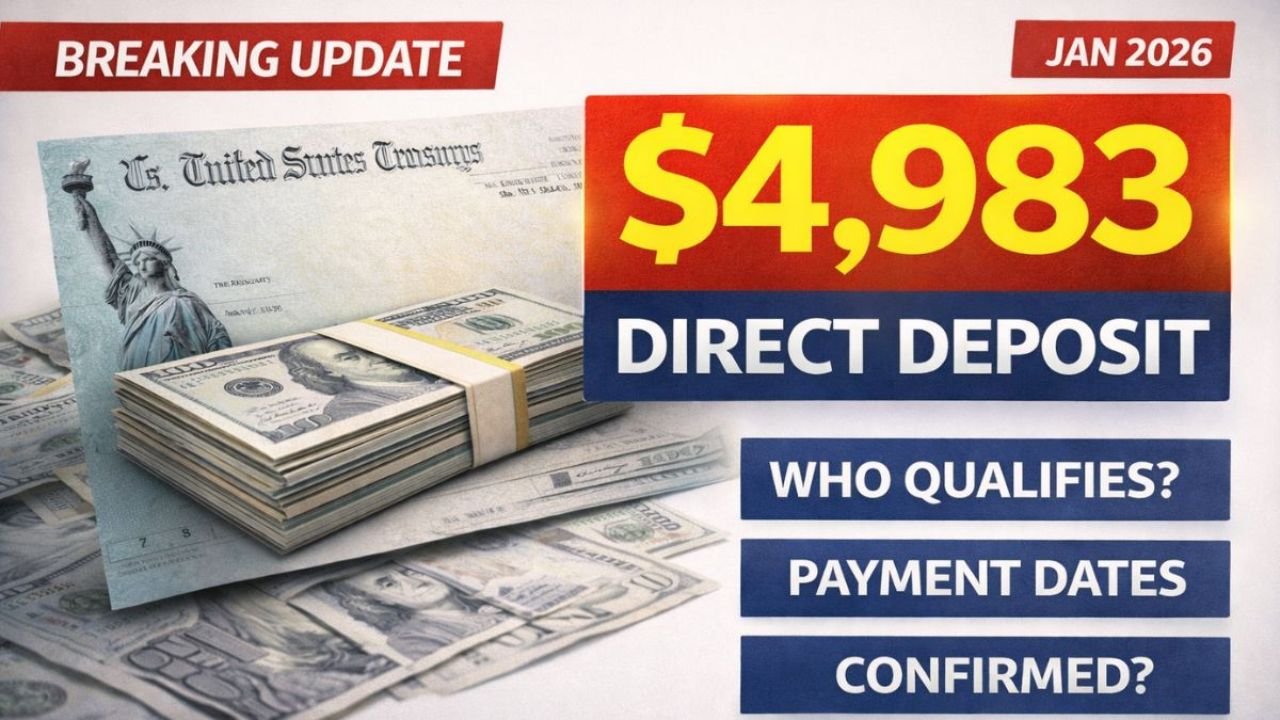
As January 2026 approaches, online discussion around a so-called $4,983 direct deposit has intensified. Social media posts, short videos, and benefit forums are repeating the figure with growing urgency, often implying that a large federal payment is about to arrive for everyone. With household budgets still strained by high rent, food costs, insurance premiums, and medical expenses, it is easy to see why this claim has captured so much attention.
However, once the headlines are set aside, the reality looks very different. The $4,983 amount is not connected to a new stimulus check or a universal government payout. Instead, it reflects how existing federal benefit systems can sometimes generate unusually large deposits when multiple adjustments occur at the same time.
Why the $4,983 Amount Is Circulating Online

The figure did not appear randomly. It is most likely based on real but highly specific situations where individuals received combined payments in a single deposit. At the start of a new calendar year, several federal systems update simultaneously. Annual cost-of-living adjustments take effect, delayed payments from the prior year may be released, and benefit recalculations are processed when eligibility details change.
When these updates align, the result can be a deposit that looks much larger than a typical monthly payment. For example, a recipient may receive their regular January benefit, plus retroactive increases covering previous months, plus a corrected payment that was previously delayed. Added together, these amounts can approach a total like $4,983.
This does not mean the payment is standard or widely available. It simply reflects how multiple adjustments can stack for certain individuals under specific circumstances.
No New $4,983 Stimulus Program Exists

One of the most common misconceptions is that the $4,983 figure represents a newly approved federal stimulus payment. There has been no announcement from Congress, the IRS, or any federal agency confirming a nationwide payment of this amount. No legislation has authorized a universal $4,983 deposit for all Americans in January 2026.
What is happening instead is that individual payment examples are being shared online without context. When those examples are repeated as headlines, they can create the false impression that everyone qualifies for the same payment. Federal benefit programs do not work that way.
Each program follows its own rules, eligibility requirements, and payment structure. A deposit received by one person may reflect years of benefit history and recent corrections, not a new policy change.
Who May See a Larger January Deposit

While there is no universal payment, some groups are more likely to notice higher-than-usual deposits in January.
Retirees and Disability Beneficiaries
People receiving long-term benefits often see annual cost-of-living increases applied at the beginning of the year. If earlier underpayments or processing delays occurred, those amounts may be corrected at the same time. When retroactive adjustments are included, the January deposit can be significantly larger than normal.
Households With Benefit Recalculations
Changes in income, household size, or eligibility category can trigger benefit recalculations. If an adjustment applies retroactively, the updated amount may be paid as a lump sum. This can create a one-time deposit that appears unusually high.
Tax-Related Adjustments
Some individuals experience larger deposits due to tax-related reconciliations. If credits or adjustments were partially issued earlier and later corrected, the combined payment may arrive as a single direct deposit. These cases are individual and depend on personal filing history.
Why January Is a Key Month for Payment Changes
January is one of the busiest months for federal payment systems. New annual rules take effect, benefit formulas are updated, and agencies work through outstanding cases from the previous year. This creates a period where multiple updates can be processed together.
Payment timing can also be affected by weekends and federal holidays. Funds may be released on one date but appear in bank accounts a day or two later, depending on the financial institution. When people compare deposits online without considering these timing differences, confusion spreads quickly.
How Misinformation Gains Momentum
Large dollar figures attract attention, especially during times of economic stress. A headline promising nearly $5,000 spreads far faster than a detailed explanation about benefit recalculations. As posts are shared, important context is often lost.
Scammers also take advantage of the excitement. Messages urging people to register, confirm details, or click links to receive the $4,983 payment are common red flags. Government agencies do not request personal or banking information through unsolicited messages, texts, or social media posts.
How to Stay Informed and Protected
The most reliable way to understand your payments is to focus on the programs you are actually enrolled in. Keep your personal details, banking information, and contact information updated with the relevant agencies. Review official notices carefully, as they often explain adjustments and retroactive payments in detail.
If a deposit seems unusually large, it is usually tied to past adjustments rather than a surprise benefit. Checking your benefit statements or official online account can clarify the source. When in doubt, speaking with a qualified professional or contacting the appropriate agency directly can provide accurate answers.
What the $4,983 Claim Really Means
The discussion around a $4,983 direct deposit in January 2026 reflects how easily financial rumors can spread when people are under pressure. While some individuals may receive deposits near this amount due to combined adjustments, there is no confirmed universal payment.
Outcomes depend entirely on personal benefit enrollment, payment history, and program-specific rules. Understanding this difference helps replace uncertainty with clarity and supports better financial planning.
The Bottom Line
There is no nationwide $4,983 direct deposit approved for January 2026. The figure comes from individual cases where multiple benefit updates, corrections, or retroactive payments were processed together. These situations are real but limited and highly specific.
Instead of focusing on viral numbers, it is more useful to pay attention to your own benefit records and official communications. Doing so helps avoid false expectations and protects against misinformation in an increasingly noisy online environment.
Disclaimer
This article is for informational and educational purposes only. The $4,983 direct deposit discussed is not a confirmed universal government payment. Payment amounts, eligibility, and timing depend on individual circumstances and official program rules, which may change. This content does not provide financial or legal advice. Readers should consult official government sources or qualified professionals for guidance specific to their situation.